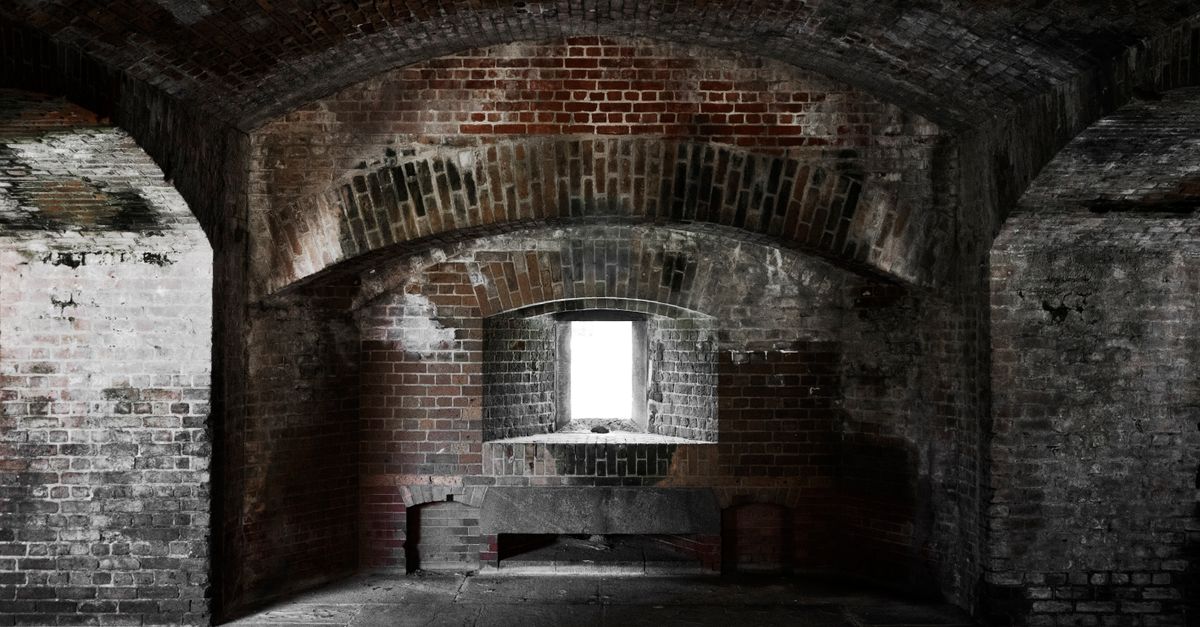
Fort Clinch State Park sits at the northern tip of Amelia Island, where a five-sided brick fort begun in 1847 still guards Cumberland Sound at the mouth of the St. Marys River. The park is open every day of the year from 8 a.m. to sundown, and a vehicle carrying up to eight people pays $6 to get in. Inside you'll find two campgrounds, a long Atlantic beach, an off-road bike trail, surf fishing, and the fort itself.
Across the water, close enough to pick out with binoculars, is Cumberland Island, Georgia. The St. Marys River is the state line right here, which is the whole reason the fort exists: its guns once covered one of the busier shipping channels on the South Atlantic coast. From the entrance station, about 3.3 miles of paved road runs out to the point, passing both campgrounds and the beach turnoff on the way. Drive it on a clear morning and you can watch a container ship slide past the ramparts.
What happened at Fort Clinch?
Fort Clinch was started in 1847, seized by Confederate troops in 1861, and taken by Union forces in March 1862 without a fight. It was never finished, and it never saw a real battle. The fort was named for General Duncan Lamont Clinch, a veteran of the War of 1812 and the Seminole Wars who owned land in the area.
It was a Third System coastal fort, the same generation as Fort Sumter and Fort Pulaski, and like a lot of them it was already going obsolete by the time rifled artillery arrived. Florida militia held it for the Confederacy for less than a year. As Union forces pushed down the coast in early 1862, the Confederates pulled out, and federal troops occupied the empty fort that March. It saw a little use again during the Spanish-American War in 1898, then went quiet for decades.
The state of Florida bought the property in 1935, and the Civilian Conservation Corps spent the rest of the 1930s rebuilding the brickwork. That CCC work is why the place is one of the better-preserved 19th-century forts you can walk through today, and why it became a state park in the first place.
What is there to do at Fort Clinch?
You can tour a restored 1860s fort, camp beside the Atlantic, ride an off-road bike trail, surf fish, swim, and hunt for shark teeth on the beach. On the first full weekend of most months, costumed volunteers garrison the fort as a Union (sometimes Confederate) unit, cooking over wood fires and firing the cannon. The fort's two levels of gun galleries are open to climb, and a restored barracks and blacksmith shop sit inside the walls.
The beach runs along the park's ocean side and stays quieter than the public beaches farther south, partly because you have to pay the gate fee and drive in to reach it. From May through October it's an active sea-turtle nesting beach, so you'll see marked nests roped off above the tide line. Bring water; the live oaks shade the road, but the dunes give you nothing.
The unpaved trail loop is a local favorite for mountain bikes, winding past a freshwater pond where gopher tortoises and the occasional alligator turn up. Birders come for the painted buntings in spring. None of it is steep, but the soft sand on the back stretches will find your legs.
One thing to check for 2026: Florida State Parks closed the fort complex temporarily starting June 22, 2026. The rest of the park, including the beach and both campgrounds, stayed open, but confirm the fort interior is back open before you build a visit around it.
Is the Fort Clinch fishing pier open?
No. The half-mile fishing pier that once reached out into the sound was severely damaged by Hurricane Matthew in October 2016 and later removed. Florida State Parks has a replacement in the works, a long-term project estimated near $2 million that could take up to a decade, and as of 2026 there is no confirmed reopening date.
You can still fish here, just not from a pier. Surf fishing off the beach and along the shoreline near the point is productive, especially on a moving tide. If pier fishing is the whole reason for the trip, the George Crady Bridge fishing pier sits at the south end of the island inside Amelia Island State Park, a separate park with its own guide.
What does it cost, and when is it open?
Entry is $6 per vehicle, the gate is open 8 a.m. to sundown every day of the year, and the fort and visitor center keep shorter hours, roughly 9 a.m. to 5 p.m. Entry is paid per vehicle at the gate, and the fort carries a small separate admission.
| What | Cost |
|---|---|
| Vehicle, 2 to 8 people | $6 |
| Single-occupant vehicle | $4 |
| Pedestrian, cyclist, or extra passenger | $2 per person |
| Fort admission (ages 6 and up) | $2.50 per person |
Camping is reserved separately. Florida State Parks lets you book a site up to 11 months in advance, and for summer weekends and the holiday weeks you'll want to be ready the morning that window opens. Before a trip that hinges on the fort interior or a specific campsite, confirm current hours and closures on the official park page. A coastal park like this one closes sections for weather and repairs more often than an inland one does.
What is Fort Clinch known for?
Fort Clinch is known as one of the most complete 19th-century masonry forts in the country, and for the living-history program that keeps it from feeling like a static museum. On reenactment weekends the garrison drills with period rifles and runs the place as if it were 1864. In the cooler months the park offers candlelight tours, where a guide in uniform walks you through the fort by lantern after dark.
Locals know it for the beach at the point and the long view north to Cumberland Island. It's also one of the few places on this stretch of coast where the open Atlantic, a tidal sound, and a salt marsh all meet inside a couple of miles, which is why the fishing and the birding run as good as they do. The same wide sightlines that made it a useful fort make it a fine place to watch a summer thunderstorm build out over the water and come ashore.
Does Fort Clinch State Park have cabins?
No. There are no cabins or lodges at Fort Clinch. Lodging here means camping, with about 60 sites split between two campgrounds. The Atlantic Beach campground sits out by the dunes on the ocean side, a short walk from the surf. The Amelia River campground sits back in the live oaks on the marsh side, shadier and more sheltered when the wind comes up. Both take tents and RVs, both have water and electric hookups and hot showers, and there's a primitive youth-group camp as well.
If you want a roof and a kitchen, you'll stay off-park and drive in. The historic downtown and the rental cottages a few miles south fill that gap, and the gate is an easy ten-minute drive from most of the island's north-end neighborhoods.
What it's like to live near the north end
The north end of the island is the quarter closest to the park, and proximity to Fort Clinch is a real draw up here. A morning loop through the fort gate, out to the beach, and back is the kind of routine that turns a house into a reason to stay put. Streets near the park back up to bike trails and tidal creeks, and the marsh side stays noticeably cooler in August than the open dunes.
At Salt Harbor Real Estate we field a lot of questions about which north-end streets sit closest to the park entrance and the trailheads, and which ones take on water on a king tide. That's local knowledge worth having before you write an offer, whether you're after beach access or a quiet lot under the oaks. The park isn't going anywhere, and neither is the line of cars at the gate on a holiday Saturday, so the houses within an easy ride of it tend to hold their appeal.
Frequently asked questions
What happened at Fort Clinch?
Construction on Fort Clinch began in 1847 but was never finished. Confederate troops seized the unfinished fort in 1861 and held it less than a year before Union forces occupied it in March 1862 without a fight. It saw brief use during the Spanish-American War in 1898, and the Civilian Conservation Corps restored the brickwork in the 1930s after Florida bought the property in 1935.
What is there to do at Fort Clinch?
You can tour the restored 1860s fort and climb its gun galleries, camp at one of two campgrounds, surf fish, ride the off-road bike trail, swim, and look for shark teeth on the beach. On the first full weekend of most months, costumed volunteers garrison the fort and fire the cannon, and the park runs candlelight lantern tours in the cooler months.
What is Fort Clinch known for?
Fort Clinch is known as one of the most complete and best-preserved 19th-century masonry forts in the country, and for its monthly living-history garrisons and candlelight tours. Locally it's also known for the quiet beach at the island's north point and the view across Cumberland Sound to Cumberland Island, Georgia.
Does Fort Clinch State Park have cabins?
No. Fort Clinch has no cabins or lodges. Lodging is limited to camping, with about 60 tent and RV sites split between the oceanside Atlantic Beach campground and the marsh-side Amelia River campground, plus a primitive youth-group camp. Sites can be reserved up to 11 months in advance through Florida State Parks.